
Non-Fiction · Emergency Preparedness
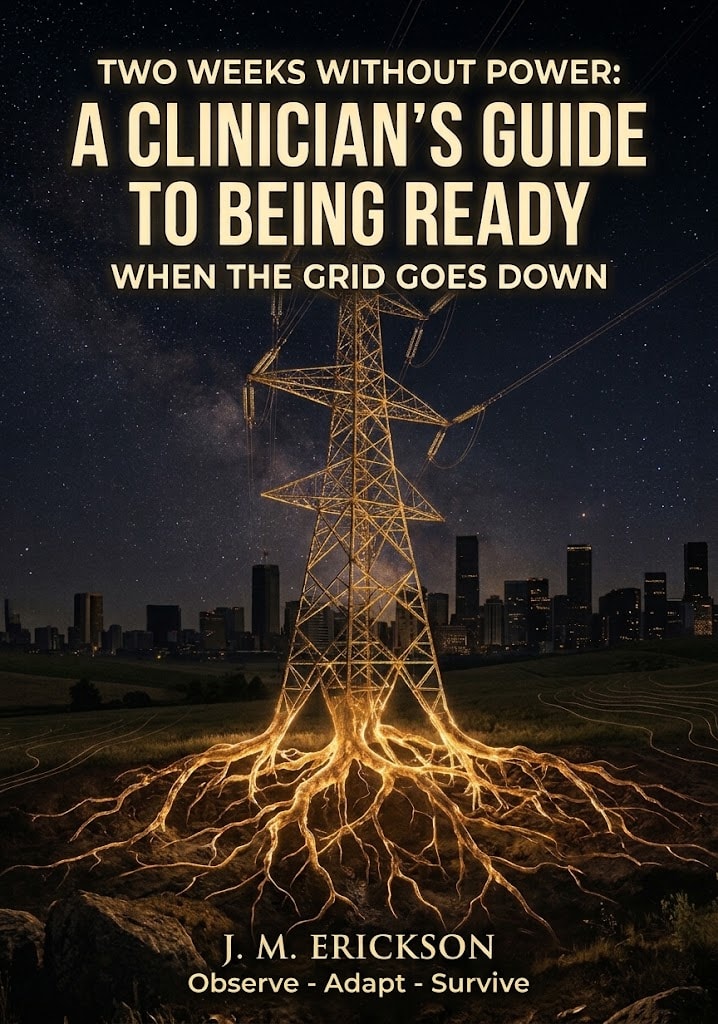
Two Weeks Without Power
A Clinician's Guide to Being Ready When the Grid Goes Down
Two Weeks Without Power is built on FEMA's own fourteen-day standard, not an author's worst-case scenario. It organizes preparation around four requirements rather than a gear list: water, food, and sanitation for fourteen days; medication with a plan for day fifteen; one room heated or cooled to survive; and four to six neighbors who would answer the door at two in the morning.
Written by a licensed clinical social worker with forty years of practice, it covers what most preparedness books skip — executive function under stress, withdrawal as a medical emergency, and how to assess a person's behavior without profiling them. Twelve chapters, twenty-one tables, eight photocopiable worksheets, and Texas City, Texas and Uxbridge, Massachusetts compared side by side.
Three things that make it different
A clinician wrote it
Other preparedness books tell you what to store. This one tells you what actually kills people first, in what order. Alcohol and benzodiazepine withdrawal can be fatal without medical management, and in a blackout there is none. Fear shuts down the frontal cortex, which is why untrained people make their worst decisions exactly when decisions matter most. Assessment is not profiling: the book gives households a way to judge conduct rather than categorize people, which is what keeps a group intact.
The standard is federal and measurable
Two weeks is FEMA's own shelter-in-place recommendation. Everything in the book either meets those four requirements or extends them past fourteen days. There is no vague advice about being better prepared. The reader always knows where they stand.
Geographically specific where every other book is generic
Texas City, Texas and Uxbridge, Massachusetts run through the same fourteen-day framework at three days, ten days, thirty, and a year. A Gulf Coast reader faces lethal heat and petrochemical risk. A New England reader faces lethal cold, frozen pipes, and the cardiac events that follow a snow shovel. Generic preparedness advice fails both.
For Media & Interviews
Seven talking points drawn from the manuscript — for interviews, panels, podcast appearances, and back-matter use.
01The standard is federal, not the author's
Two weeks is FEMA's own shelter-in-place recommendation, not a scenario invented to sell a book. A household can check itself against four requirements tonight: fourteen days of water, food, and sanitation; medication with a plan for day fifteen; one room heated or cooled to survivable temperatures; and four to six neighbors who would answer the door at two in the morning.
02Executive function is the prerequisite skill, and it goes offline first
Preparation requires the frontal cortex: the ability to focus, filter distraction, sequence actions, and regulate emotion. Acute fear reduces frontal activity and hands control to threat systems built for fight, flight, and survival. That is why untrained people make their worst decisions at exactly the moment decisions matter most. Health, community, and executive function come before equipment.
03Assessment is not profiling
Clinical assessment asks what a person needs to function and what they will do under pressure; it is aimed at keeping someone in the group. Profiling asks what category a person belongs to; it is aimed at exclusion. The workable alternative is behavioral threat assessment, which weighs observable conduct rather than psychiatric labels. A household that assesses clinically holds together; one that profiles sheds exactly the people it needs in the first week.
04The drug that kills in a grid-down scenario is the one nobody stockpiles
Alcohol and benzodiazepine withdrawal can be fatal without medical management. In a blackout there is no medical management. This is the single most life-saving line in the book and the one most likely to be skipped, because it requires a conversation with a prescriber rather than a purchase. A 90-day medication supply and a written taper plan belong in the same drawer as the water.
05Preparedness has a priority ladder, and almost everyone climbs it backwards
Health and mental health first. Then real relationships within walking distance. Then debt reduction, employment security, and savings. Then portable skills. Then affordable supplies. Gear last. Arriving at step six with steps one through three untouched produces a household full of equipment and a person who cannot use it well.
06Two towns, one framework
Texas City, Texas and Uxbridge, Massachusetts run through the same fourteen-day standard at three days, ten days, thirty, and a year. A Gulf Coast reader faces lethal heat, humidity that ruins dressings, storm debris, and petrochemical risk. A New England reader faces lethal cold, frozen pipes, ice falls, and the cardiac events that follow a snow shovel. Generic preparedness advice fails both.
07Resilience is learned, late, and on purpose
The generations raised on reliable electricity are not less capable; they were never given the tasks. Resilience is a residue left by things that hurt, and adaptability comes from having had to adapt, usually before you were ready. The manual is written for the author's own two children, born in 1995 and 1997, and for everyone raised inside an artificial biosphere of electricity, plumbing, refrigeration, and instant information.
Why J. M. Erickson Can Write This Book
Forty years of clinical practice in settings that did not allow for optimism — combined with a lifetime of hands-on training in the skills that matter when systems fail.
Clinical Practice
Licensed Independent Clinical Social Worker (LICSW) · 40+ years in locked juvenile units, inpatient admission wards, and residential programs for emotionally disturbed children.
Academic Training
B.A. Boston College (Psychology & Sociology) · M.S.W. Simmons University · Clinical training at the M.S.W. level, Children's Hospital Department of Psychiatry & Judge Baker Guidance Center, Boston (1985-1986).
Postgraduate Certificates — Boston University
Psychological Trauma: Clinical Assessment and Treatment Certificate Program (2001-2003) · Human Services Agency Management Certificate Program (1999-2001) — both awarded by the BU School of Social Work Professional Education Program.
Continuing Clinical Education
Harvard Medical School — Emerging Strategies in Assessment & Treatment of Depression and Anxiety · PESI DBT Certificate Course · NetCE coursework in anxiety disorders, mass violence, bioterrorism, and trauma-focused care.
Firearms & Tactical Training
Massachusetts Basic Firearms Safety Certificate · SIG Sauer Academy — multiple handgun and modern sporting rifle courses · SAFTD F.A.S.T. Handgun (Second Amendment Foundation Training Division) · Visiting Lecturer, Cambridge Police Academy — June 25, 1992, recognized by C.P.D. Academy Director George Bowen; affiliated at time of award: Assured Health Systems Inc., ACSW, LICSW · Four decades of continuous clinical practice assessing danger to self, harm to others, and public safety.
Martial Arts & Communications
Shodan (1st-degree black belt), American Kenpo — recognized as Sensei, Nick Cerio's International Martial Arts Association (1994) · Licensed amateur radio operator — emergency communications background.
Senior Clinician & University Instructor
Graduate School Instructor, Cambridge College — School of Psychology & Counseling (2006-2020) · Senior Clinician, Integrated Behavioral Health, LLC / General Psychological Associates, Essex County, MA (2004-2026) · Visiting Lecturer, Cambridge Police Academy (1992) · 14 years teaching graduate-level psychology and counseling.
"This manual is what I know, compressed. It is written for my own two children and for everyone raised the way they were — inside an artificial biosphere of electricity, plumbing, refrigeration, and instant information, with no experience of what happens when those things stop."